
Disclaimer (or not, I’m comfortable with it): I co-edited this piece, based on my initial thoughts, with seven LLMs, using their default versions as of 2026-11-15 (Claude, ChatGPT, Gemini, DeepSeek, Qwen, Grok, and Mistral). What mattered to me was the essence of the argument more than the exact wording. The final version is my own (is it? Has this been settled yet? I don’t know). Any remaining errors are mine, and I take full responsibility for them. Read it from end to end; skip whatever you don’t fully get.
The subject is in the disclaimer.
Since the Thélyson Orélien “scandal”, I’ve been thinking about whether a classifier can actually detect a writing style. No, I’m not a Natural Language Processing expert (yet). But I’ve used classifiers a bit and seen some of their results. In this post, I’ll look at what a detector’s output numbers can—and cannot—tell us about who wrote a text. I won’t settle the authorship question. I do think, however, that the case raises some important points.
The case
In September 2026, Haitian-Canadian writer Thélyson Orélien won the Prix Première Plume for his debut novel, C’était ça ou mourir, published by Grasset [1]. A few weeks later, an X account called “Balance ton Claude” accused him of having written much of the book with generative AI. One of the account’s co-creators said he had analyzed excerpts using Pangram [2]. According to press reports, the detector returned a “100% probability” that the text was AI-generated [3].
Orélien denied that a single sentence of the novel had been produced by a machine, while acknowledging plagiarism in some older texts and apologizing for it [2,3]. His publisher, Boréal, initially stood by him [3]. On 21 October, however, it announced that AI had been used, citing new information without specifying exactly what it was. It also acknowledged that the extent of the use remained unknown [4].
I’m not going to settle the case here. It is, in many ways, 100% representative of the permanent hysteria that now seems to accompany every online debate. But one thing is worth separating from the rest: the detector’s score became part of a public accusation. A score can be statistical evidence, and it can be challenged or manipulated through the experimental protocol. It is not proof of authorship.
There is also a basic distinction worth keeping in mind: the percentages reported by Pangram are shares of text, not probabilities that a person used AI. We’ll come back to that.
A small experiment in adversarial reviewing
The scandal hasn’t stopped me from using AI, though. At least for one thing: adversarial paper-reviewing.
Since ChatGPT’s arrival in 2023, the flood of LLM-written and LLM-polished papers has made it increasingly difficult to separate useful work from AI slop. I don’t want to waste time reviewing submissions that are obviously wrong or contain fabricated claims. And, because of my specific context, I also have to account for the not so occasional troll, clown, or their entire gang.
So I started experimenting with what I call adversarial review. Several LLMs independently review a paper, looking for flaws. Their reviews are then confronted with one another, and the disagreements become part of the process. It is closer to a review panel than to Daniel Kahneman’s idea of adversarial collaboration, where opponents jointly design an experiment [7]. But the spirit is similar: let disagreement do the work.
I tried this approach on Pangram’s technical report [8], using seven LLMs: one main reviewer and six independent reviewers. Each first produced a review of its own. The main reviewer then consolidated the feedback, and the group went through several rounds until it reached what I considered a reasonably satisfying consensus.
The report offered a useful case study: not only in AI-text detection, but in how much trust we should place in a headline number.
How much can we trust the headline number?
Pangram 4’s technical report gives three impressive figures: an AUROC of 0.9916, a false positive rate (FPR) of 0.0041%, and a false negative rate (FNR) of 0.3396% [8].
A 0.99 AUROC is often a reason to look more closely when dealing with messy real-world data. But before getting to that, let’s unpack the numbers.
A classifier takes a text and labels it either “AI” or “Human”. That gives us four possible outcomes:
| Actual text | Verdict: “AI” | Verdict: “Human” |
|---|---|---|
| AI | True positive (TP) | False negative (FN) |
| Human | False positive (FP) | True negative (TN) |
The rates below are calculated row by row: each one tells us what proportion of texts in a given actual category received a particular verdict.
| Rate | Formula | In words | Pangram 4 [8] |
|---|---|---|---|
| False negative rate (FNR) | FN / (TP + FN) | AI texts incorrectly classified as human | 0.3396% |
| True positive rate (TPR, sensitivity) | 1 − FNR | AI texts correctly classified as AI | 99.6604% |
| False positive rate (FPR) | FP / (FP + TN) | Human texts incorrectly classified as AI | 0.0041% (≈ 1 in 24,000) |
| True negative rate (TNR, specificity) | 1 − FPR | Human texts correctly classified as human | 99.9959% |
These numbers describe performance at a particular classification threshold. But a detector doesn’t just produce a yes-or-no verdict: it first gives each text a score. A threshold determines whether that score is interpreted as “AI” or “Human”.
Lowering the threshold means more texts are classified as AI. That catches more AI-generated texts, increasing the true positive rate, but it also means more human texts get wrongly flagged, increasing the false positive rate. Raising the threshold does the opposite.
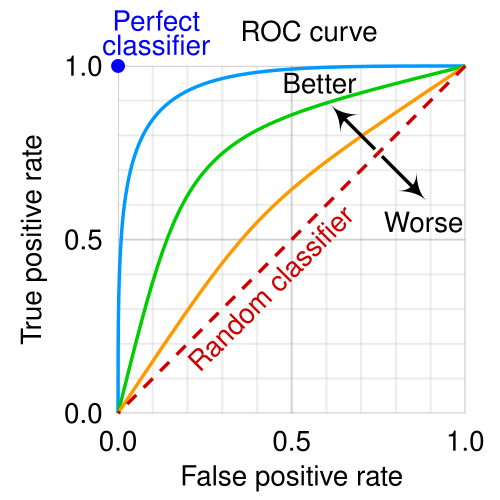
The ROC curve lays out all these possible trade-offs, plotting the true positive rate against the false positive rate as the threshold changes. The AUROC—the area under that curve—summarizes the detector’s performance across all thresholds, rather than at just one particular setting.
There is a more intuitive way to understand AUROC [9]. Imagine a tournament in which every AI text competes against every human text. The detector wins a duel whenever it gives the AI text a higher score than the human text. The AUROC is the proportion of duels it wins.
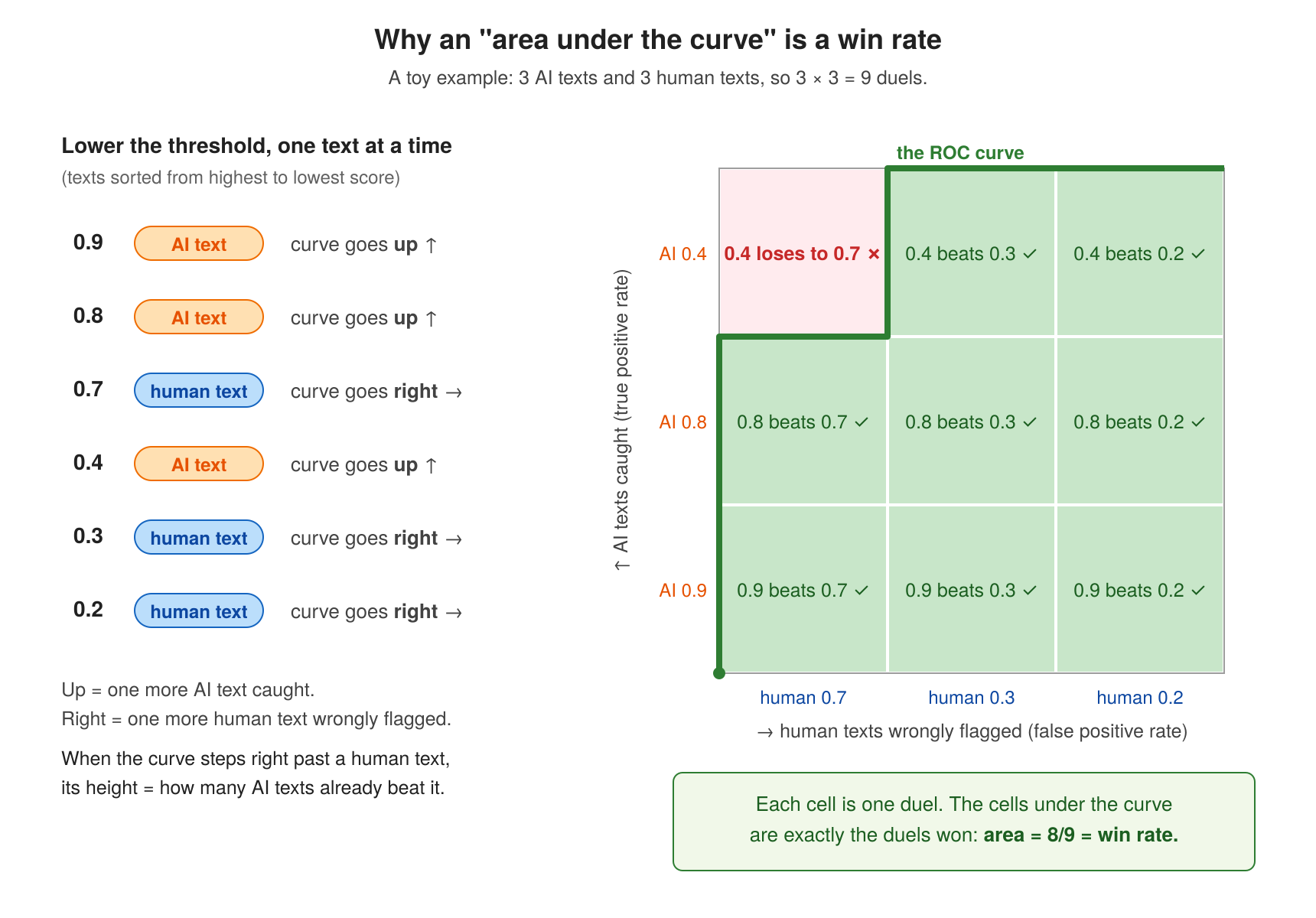
Why does an area correspond to a win rate? Consider a toy example with three AI texts, scored 0.9, 0.8, and 0.4, and three human texts, scored 0.7, 0.3, and 0.2. There are nine possible duels.
As we lower the threshold, the ROC curve moves up whenever an AI text is passed and right whenever a human text is passed. Each cell in the 3 × 3 grid represents one duel. The cells under the curve correspond exactly to the duels in which the AI text has the higher score.
In this example, the detector wins eight out of nine duels. Its AUROC is therefore 8/9.
A small problem with the reported AUROC
Now let’s return to Pangram’s figures.
The report gives a true positive rate of 99.6604% and a true negative rate of 99.9959%. In section 5.1, it explains that the AUROC ranks texts according to a post-processed, weighted share of AI characters. The final verdicts are based on those same character shares: a score of at least 0.8 means “AI”, while a score of at most 0.1 means “Human” [8].
That creates an interesting constraint.
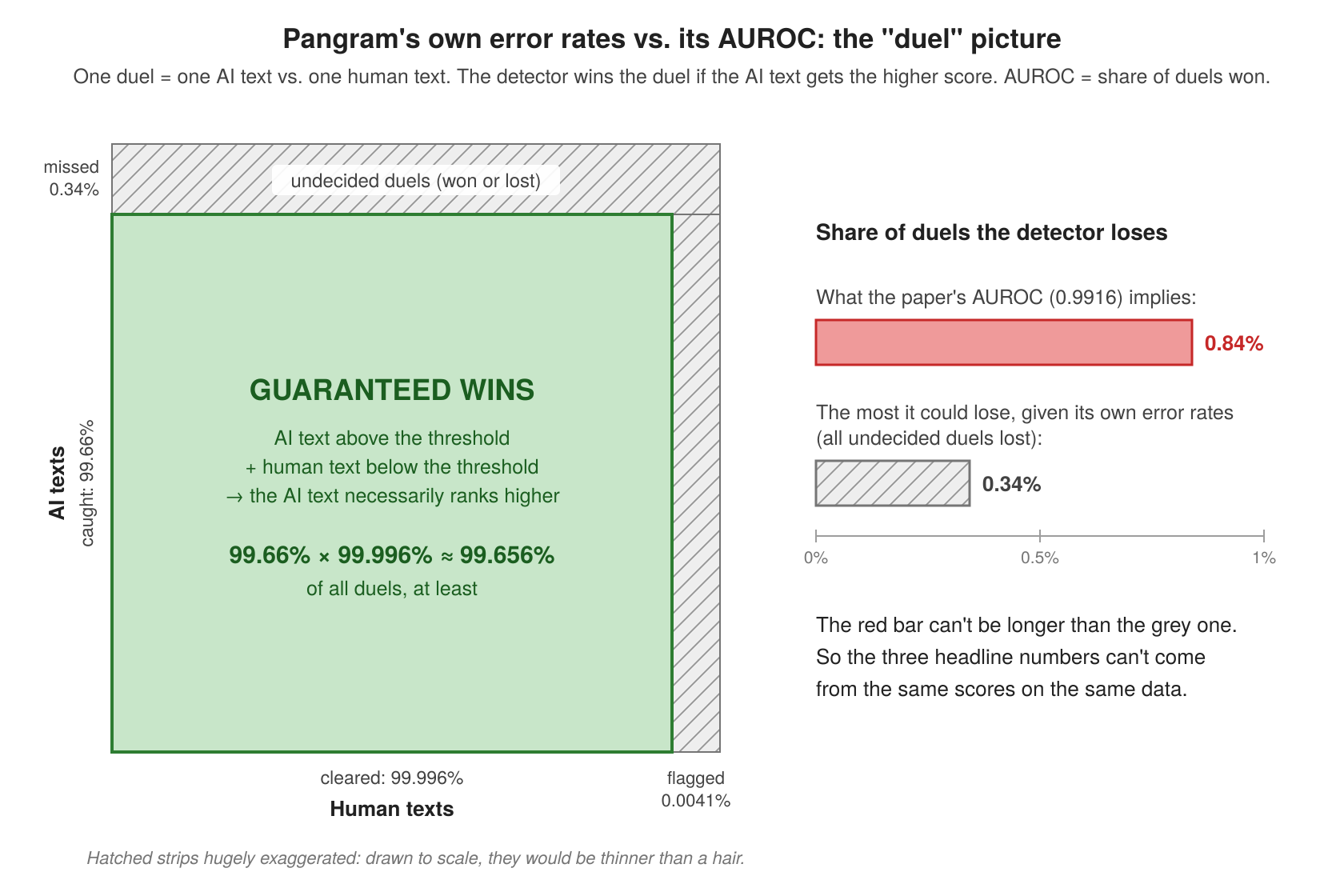
Every duel between a true positive and a true negative is guaranteed to be a win for the detector: the AI text has a score of at least 0.8, while the human text has a score of at most 0.1.
The proportion of all possible duels of this kind is simply:
[ TPR \times TNR = 99.6604\% \times 99.9959\% \approx 99.656\%. ]
So at least 99.656% of all duels must be wins. The remaining 0.344% are undecided: the detector could win or lose them.
Even in the worst possible case, where it loses every one of those remaining duels, its AUROC cannot be lower than 0.99656.
That’s a lower bound, not an estimate. Given the report’s own error rates, the AUROC should be somewhere between 0.99656 and 1—provided the rates and the AUROC are computed on the same texts, with the same definitions and the same underlying score.
But the report gives an AUROC of 0.9916. That implies a loss rate of 0.84% of all duels, more than twice the maximum 0.344% that the reported error rates would allow.
There are several possible explanations. The contradiction only holds if all three figures are calculated on the same texts, if the AUROC ranks the same final scores used to produce the verdicts, and if the same definitions of positive and negative are used throughout.
The report doesn’t establish all of these conditions. It gives the AUROC in the abstract, but doesn’t clearly identify the texts used to calculate it. Perhaps the AUROC was measured on a different evaluation set. Perhaps the metrics were calculated at different levels, such as text segments versus whole documents. Or perhaps the figure was simply reported incorrectly.
We can’t tell from the report alone.
Funnily enough, the problem isn’t that the AUROC is too good: it sits below the floor set by the report’s own error rates.
Of the six other LLM reviewers, one reached the same conclusion. Four repeated the 0.9916 figure without questioning it, and one omitted it altogether. Again: an anecdote, not a statistic.
Is an AUROC of 0.99 suspicious?
In a noisy, real-world tabular classification problem, an AUROC close to 1 is often a reason to investigate possible feature leakage. But the key question is whether the test set resembles the data the model will encounter in practice.
In AI-text detection, near-perfect scores are not unusual when the test data closely resemble the training data. Pangram’s appendix includes a DetectRL benchmark in which a supervised RoBERTa model reaches an AUROC of 99.98% in-domain, while its F1 score drops to 83 on an unseen domain [8].
The distinction matters. Raw chatbot output compared with pre-ChatGPT human writing can be relatively easy to separate. Edited, mixed, or paraphrased text encountered in everyday use is a much harder problem.
So the right question isn’t “Is 0.99 too high?” It’s “How much does the test set look like the real world?”
There are at least three ways a benchmark can fail to answer that question.
First, overfitting. If researchers repeatedly tune a model against the same test set, they gradually adapt it to that particular set, even if they never train directly on it.
Second, mismatch. A test set may not represent the data the model will encounter in practice. A model can perform brilliantly on one kind of text and struggle on another.
Third, obsolescence. The test set may no longer reflect current chatbots or contemporary human writing.
A meta-analysis of more than 100 Kaggle competitions found little evidence of overfitting to public leaderboards [10]. One reason is that the public and private leaderboard sets were random draws from the same underlying pool. The situation becomes more complicated when the test data don’t represent the same population.
For example, researchers rebuilt the ImageNet test set using the original collection procedure. Model accuracy fell by 11–14%, although the relative rankings of models remained mostly stable [11]. The models hadn’t simply memorized the test images; they had learned to exploit aspects of the test set that made it easier than the broader task.
Repeatedly using a test set also erodes its value. One proposed solution is to ration access to it, preserving a holdout set for evaluation [12].
AI detectors face all three problems, plus one: contamination. Public benchmarks may end up in the training data of the very models being evaluated. When a vendor says it hasn’t trained on a benchmark, you often have to take its word for it—or avoid relying on that evaluation altogether.
What exactly is a detector detecting?
So far, I’ve questioned one number. But even a perfectly measured number leaves a bigger question: what, exactly, is being detected?
A classifier detects patterns. It might pick up on word choices, sentence structures, punctuation, or habits involving semicolons and dashes. This is not fundamentally different from traditional authorship attribution. Researchers have, for example, used word frequencies to argue that James Madison wrote disputed Federalist Papers [13].
But writing style isn’t fixed. It changes with age, experience, influences, and what we read. Editors, co-authors, spellcheckers, and now LLMs can all contribute to a text. At some point, the idea of a purely individual writing style becomes difficult to sustain.
Pangram’s report acknowledges part of this problem. It introduces an “AI-assisted” category for texts with entangled authorship (§3.3), and notes that detecting human writing influenced by LLMs remains an open problem (§6) [8].
To understand why, it helps to think about how chatbots are trained.
The first stage is pretraining: a model is exposed to enormous amounts of text and learns to predict the next word. In doing so, it learns patterns in human writing, including unusual expressions and awkward turns of phrase. If that were the whole story, a chatbot would be little more than an autocomplete system for the internet.
But it isn’t. A second stage teaches the model how to respond to instructions. This typically involves supervised fine-tuning on prompts and preferred answers [14], followed by some form of preference or reward optimization. Methods such as direct preference optimization [15] and constitutional AI [16] are part of this broader family of techniques.
In a sense, this second stage acts like an editor. But it doesn’t edit an individual text in the way a human editor would. It edits the distribution from which future texts are generated. Every future response is, in a sense, pre-edited.
And this editor is not one person with a distinctive taste. It is closer to a committee of raters whose preferences tend to average out. That can make the resulting writing more uniform and reduce diversity [17].
There is another step. During generation, sampling methods such as top-k and nucleus sampling help avoid the blandness of always choosing the most probable next word, while also preventing the model from wandering too far into unlikely sequences [18]. These methods can further shape the range of language that appears in the final output.
Of course, even the human text used in the first stage was already edited to some extent: books, newspapers, encyclopedias, and other published writing have passed through their own editorial processes.
My hypothesis is that detectors are often picking up on this accumulated editing, rather than some essential quality of “machine-ness”. This could help explain why heavily edited human writing, especially academic prose, can be flagged as AI-generated. In one experiment, Pangram’s errors were concentrated in academic writing and essays by non-native English speakers (§4.1) [8].
There is another possible explanation for the latter: the detector’s reference corpus of human writing may be too narrow. Language that falls outside its idea of typical human writing can then look AI-generated.
These explanations are not mutually exclusive. But they lead to a testable prediction: within the same writing register, heavily edited human writing should be flagged as AI more often than lightly edited writing.
How far apart must the distributions be?
There is also a theoretical result worth considering.
A paper by Sadasivan and colleagues [19] gives an upper bound on the AUROC of any detector:
[ AUROC \leq \frac{1}{2} + TV - \frac{TV^2}{2}, ]
where (TV) is the total variation distance between the distributions of human-written and AI-generated text. It ranges from 0, when the distributions are identical, to 1, when they are completely separated.
Rearranging the inequality, an AUROC of 0.99 requires a total variation distance of at least approximately 0.86. For Pangram’s reported AUROC of 0.9916, the required distance is approximately 0.87.
This doesn’t tell us the actual distance between the two distributions. It tells us how far apart they must be, at a minimum, for a detector to achieve the reported AUROC.
In other words, the AI and human texts in Pangram’s test set must be quite different.
Another result suggests that detection is possible whenever the two distributions are not exactly identical, but that the closer they are, the more text is needed to distinguish them [20]. Estimating the share of AI-generated text across a large collection of web pages may therefore be feasible, while judging whether a single short student essay was written by AI is much harder.
And as humans increasingly pick up LLM habits, the distinction may become even less clear. Future models trained on web data containing large amounts of AI-generated text could also contribute to a loss of linguistic diversity [21].
Asymptotically, the question isn’t “human or machine?” anymore, but “isn’t all of this human?”
Three different questions
I think it helps to distinguish three questions that often get conflated:
- Does this text resemble the output of a language model?
- Was this text actually produced or substantially changed by AI?
- Who is responsible for what the text says?
A classifier can reasonably try to answer the first question. But that doesn’t automatically answer the second, and it certainly doesn’t answer the third.
For the second, provenance may be more useful than style. Watermarking is one possible approach [22]. Verifiable records of how a text was produced could also help. These methods require cooperation and can be attacked or circumvented [19], but at least they address a more clearly defined question.
The third question is not something a classifier can answer.
There is also a problem of causation. A detector may find a correlation between certain linguistic patterns and AI-generated text, but that doesn’t establish that AI caused those patterns. If human and AI texts are already similar, a classifier trained on examples of each may not be able to distinguish the underlying causes.
And a detector’s score should not automatically be interpreted as a probability of authorship. Pangram’s report explicitly says that its confidence score is not a calibrated probability that the label is correct (§4.3.5) [8].
Finally, there is the problem of reproducibility. Commercial incentives and scientific transparency don’t always point in the same direction. Pangram’s report describes its model backbone only as “a popular open-weight MoE model” (§4.1) [8]. That makes it difficult for outsiders to reproduce the system.
The evaluation data matter just as much. In its Pangram 4.1 model card, the company says it revisited the English human test set behind earlier headline numbers and removed “junk text such as spam, advertising and programmatically generated documents” [23].
The company describes the cleaned set as more challenging. The recalibrated false positive rate is approximately 1 in 10,000, compared with 1 in 24,000 for Pangram 4. That is 2.4 times higher. The model version also changed, so we can’t isolate the effect of cleaning the test set. But it does illustrate how much a headline number can depend on the evaluation data.
I get it, though: if I open-source my adversarial reviewer, will I make millions, or the opposite?
So, what matters?
All of which brings me back to the question underneath the metrics.
What’s important eventually: the pleasure of reading? Whether someone wrote it with ink from Tanzania or Mongolia? Or whether it reflects more precisely what’s inside their heart?
References
[1] Livres Hebdo (2026, September 3). Thélyson Orélien, lauréat du prix Première Plume 2026. https://www.livreshebdo.fr/article/thelyson-orelien-laureat-du-prix-premiere-plume-2026
[2] Sud Radio / AFP (2026, October 13). Thélyson Orélien dément avoir utilisé l’IA mais reconnaît des plagiats. https://www.sudradio.fr/societe/thelyson-orelien-dement-avoir-utilise-lia-mais-reconnait-des-plagiats
[3] Kuwait Times / AFP (2026, October 14). Canadian publisher supports Orelien after AI denial. https://kuwaittimes.com/article/51626/lifestyle/art-fashion/canadian-publisher-supports-orelien-after-ai-denial/
[4] Euronews (2026, October 21). Thélyson Orélien row: publisher says AI used to write “C’était ça ou mourir”. https://www.euronews.com/2026/10/21/thelyson-orelien-row-publisher-says-ai-used-to-write-cetait-ca-ou-mourir
[5] Kobak, D., González-Márquez, R., Horvát, E.-Á., & Lause, J. (2025). Delving into LLM-assisted writing in biomedical publications through excess vocabulary. Science Advances, 11(27), eadt3813. https://doi.org/10.1126/sciadv.adt3813
[6] Liang, W., Zhang, Y., Wu, Z., Lepp, H., et al. (2024). Mapping the increasing use of LLMs in scientific papers. COLM 2024. https://arxiv.org/abs/2404.01268
[7] Mellers, B., Hertwig, R., & Kahneman, D. (2001). Do frequency representations eliminate conjunction effects? An exercise in adversarial collaboration. Psychological Science, 12(4), 269–275. https://doi.org/10.1111/1467-9280.00350
[8] Glickenhaus, B., Thai, K., Russell, J., Masrour, E., Han, Y., Spero, M., & Emi, B. (2026). Pangram 4 Technical Report. arXiv:2607.27183. https://arxiv.org/abs/2607.27183
[9] Hanley, J. A., & McNeil, B. J. (1982). The meaning and use of the area under a receiver operating characteristic (ROC) curve. Radiology, 143(1), 29–36. https://doi.org/10.1148/radiology.143.1.7063747
[10] Roelofs, R., Shankar, V., Recht, B., Fridovich-Keil, S., Hardt, M., Miller, J., & Schmidt, L. (2019). A meta-analysis of overfitting in machine learning. NeurIPS 32. https://papers.nips.cc/paper/9117-a-meta-analysis-of-overfitting-in-machine-learning
[11] Recht, B., Roelofs, R., Schmidt, L., & Shankar, V. (2019). Do ImageNet classifiers generalize to ImageNet? Proceedings of ICML, PMLR 97, 5389–5400. https://arxiv.org/abs/1902.10811
[12] Dwork, C., Feldman, V., Hardt, M., Pitassi, T., Reingold, O., & Roth, A. (2015). The reusable holdout: Preserving validity in adaptive data analysis. Science, 349(6248), 636–638. https://doi.org/10.1126/science.aaa9375
[13] Mosteller, F., & Wallace, D. L. (1963). Inference in an authorship problem. Journal of the American Statistical Association, 58(302), 275–309. https://gwern.net/doc/statistics/bayes/1963-mosteller.pdf (expanded as the 1964 book Inference and Disputed Authorship: The Federalist: https://casbs.stanford.edu/inference-and-disputed-authorship-federalist)
[14] Ouyang, L., Wu, J., Jiang, X., et al. (2022). Training language models to follow instructions with human feedback. NeurIPS 35. https://arxiv.org/abs/2203.02155
[15] Rafailov, R., Sharma, A., Mitchell, E., Manning, C. D., Ermon, S., & Finn, C. (2023). Direct preference optimization: Your language model is secretly a reward model. NeurIPS 36. https://proceedings.neurips.cc/paper_files/paper/2023/hash/a85b405ed65c6477a4fe8302b5e06ce7-Abstract.html
[16] Bai, Y., Kadavath, S., Kundu, S., Askell, A., et al. (2022). Constitutional AI: Harmlessness from AI feedback. arXiv:2212.08073. https://arxiv.org/abs/2212.08073
[17] Kirk, R., Mediratta, I., Nalmpantis, C., Luketina, J., Hambro, E., Grefenstette, E., & Raileanu, R. (2024). Understanding the effects of RLHF on LLM generalisation and diversity. ICLR 2024. https://arxiv.org/abs/2310.06452
[18] Holtzman, A., Buys, J., Du, L., Forbes, M., & Choi, Y. (2020). The curious case of neural text degeneration. ICLR 2020. https://arxiv.org/abs/1904.09751
[19] Sadasivan, V. S., Kumar, A., Balasubramanian, S., Wang, W., & Feizi, S. (2023). Can AI-generated text be reliably detected? arXiv:2303.11156. https://arxiv.org/abs/2303.11156
[20] Chakraborty, S., Bedi, A. S., Zhu, S., An, B., Manocha, D., & Huang, F. (2023). On the possibilities of AI-generated text detection. arXiv:2304.04736. https://arxiv.org/abs/2304.04736
[21] Shumailov, I., Shumaylov, Z., Zhao, Y., Papernot, N., Anderson, R., & Gal, Y. (2024). AI models collapse when trained on recursively generated data. Nature, 631, 755–759. https://doi.org/10.1038/s41586-024-07566-y
[22] Kirchenbauer, J., Geiping, J., Wen, Y., Katz, J., Miers, I., & Goldstein, T. (2023). A watermark for large language models. Proceedings of ICML, PMLR 202, 17061–17084. https://arxiv.org/abs/2301.10226
[23] Pangram Labs (2026). Pangram 4.1 Model Card. https://www.pangram.com/research/model-card/pangram-4-1
For attribution, please cite this work as:
T. Moudiki (2026-11-28). On the Thélyson Orélien 'scandal' and the use of AI for writing. Retrieved from https://thierrymoudiki.github.io/blog/2026/11/28/r/python/AI-for-writing
BibTeX citation (remove empty spaces)
        @misc{ tmoudiki20261128,
          author = { T. Moudiki },
          title = { On the Thélyson Orélien 'scandal' and the use of AI for writing },
          url = { https://thierrymoudiki.github.io/blog/2026/11/28/r/python/AI-for-writing },
          year = { 2026 } }

Previous publications
- On the Thélyson Orélien 'scandal' and the use of AI for writing Nov 28, 2026
- pyr.js: Python and R in HTML, documentation and examples Nov 22, 2026
- pyr.js: Python and R in HTML pages, with one script tag Nov 15, 2026
- Using caretS3 with ahead::ctxthetaf for Time Series Forecasting Nov 7, 2026
- genbooster, mlsauce, XGBoost, LightGBM — untuned small benchmark Nov 1, 2026
- caretS3 and ahead for Tabular and Time Series Machine Learning Oct 25, 2026
- Choosing the size of the calibration set in conformal prediction with ahead::conformalize() Oct 18, 2026
- Machine-learning loss reserving vs Mack Chain-Ladder under settlement speed-up and calendar inflation (Python version) Oct 5, 2026
- mlreserve: machine-learning loss reserving on 'real-world' triangles (based on a 'ChainLadder' fork) Oct 3, 2026
- Analytics Pipeline for Dashboards, with Python, R and Javascript Sep 27, 2026
- Python version of Semi-parametric option pricing based on underlying's historical data (accepted at the osQF 2026 (ex R/Finance) conference) Sep 21, 2026
- Semi-parametric option pricing based on underlying's historical data (accepted at the osQF 2026 (ex R/Finance) conference) Sep 20, 2026
- Model-agnostic prediction intervals in Python and R: does nnetsauce's QuantileRegressor hold up? Sep 14, 2026
- ahead (Time Series Forecasting with uncertainty quantification) gets a lot faster to install: most dependencies are now optional Sep 8, 2026
- Skip the R/Python runtime: fast tabular dashboards with Observable Framework Aug 31, 2026
- PCARVFL vs CTGAN for synthetic tabular data generation on an insurance pricing dataset Aug 22, 2026
- 'Zero-Shot Probabilistic Stock Returns Forecasting with Pretrained RVFL Networks' accepted at COPA 2026 (and to appear in the Proceedings of Machine Learning Research) Aug 15, 2026
- 'PCARVFLSimulator': a GAN-like tabular data synthesizer built from PCA scores, a Random Vector Functional-Link network, and residuals bootstrapping Aug 10, 2026
- 'garchf': GARCH probabilistic forecasting with package 'forecast'-style interface (and 'rugarch' under the hood) Aug 1, 2026
- GPopt for R: Bayesian and conformal optimization of black-box functions and hyperparameter tuning Jul 26, 2026
- My last R posts: How conformalization helps weak models, fast conformal prediction with jackknife+ (and no refitting), and sklearn in R Jul 13, 2026
- Natively Interpretable Boosting Jul 12, 2026
- Fast conformal prediction (no refitting) for some Machine Learning models via closed-form jackknife plus Jun 27, 2026
- Using scikit-learn models in R easily with the tisthemachinelearner package Jun 21, 2026
- No-Code Machine Learning in Excel with the Techtonique API Jun 14, 2026
- How Conformal Prediction Makes Linear Models Good Enough — An Example Using R Package mlS3 Jun 7, 2026
- Techtonique dot net, the Machine Learning web API, is back online (but more like a passion project for now) May 31, 2026
- Conformalized TabICL: Prediction Intervals for a State-Of-The-Art Tabular Foundation Model in Python and R May 21, 2026
- Conformalized TabPFN: Prediction Intervals for a Pretrained Transformer for Tabular Data in Python and R May 17, 2026
- Probabilistic Time Series Cross-Validation with R package crossvalidation May 16, 2026
- One interface, (Almost) Every Classifier (and Regressor): unifiedml v0.3.0 May 9, 2026
- You Don't Need to Learn All the Weights on tabular data: The Case for rvflnet (a nonlinear expressive glmnet) on regression, classification and survival analysis May 2, 2026
- Survival analysis with sklearn, glmnet, keras, pytorch, lightgbm, xgboost, nnetsauce, mlsauce Part 2 Apr 28, 2026
- Any Sklearn Regressor as a Survival Model — Does It Actually Work? Benchmarking vs Established Packages Apr 26, 2026
- Conformal Optimization Beats Bayesian Optimization, Optuna and Random Search on 72 classification Datasets Apr 19, 2026
- `mlS3` — A Unified S3 Machine Learning Interface in R Apr 12, 2026
- One interface, (Almost) Every Classifier: unifiedml v0.2.1 Apr 4, 2026
- Techtonique dot net is down until further notice Apr 1, 2026
- Explaining Time-Series Forecasts with Sensitivity Analysis (ahead::dynrmf and external regressors) Mar 29, 2026
- Python version of 'Option pricing using time series models as market price of risk Pt.3' Mar 22, 2026
- Option pricing using time series models as market price of risk Pt.3 Mar 16, 2026
- Explaining Time-Series Forecasts with Exact Shapley Values (ahead::dynrmf with external regressors applied to scenarios) Mar 8, 2026
- My Presentation at Risk 2026: Lightweight Transfer Learning for Financial Forecasting Mar 1, 2026
- nnetsauce with and without jax for GPU acceleration Feb 23, 2026
- Understanding Boosted Configuration Networks (combined neural networks and boosting): An Intuitive Guide Through Their Hyperparameters Feb 16, 2026
- R version of Python package survivalist, for model-agnostic survival analysis Feb 9, 2026
- Presenting Lightweight Transfer Learning for Financial Forecasting (Risk 2026) Feb 4, 2026
- Option pricing using time series models as market price of risk Feb 1, 2026
- Enhancing Time Series Forecasting (ahead::ridge2f) with Attention-Based Context Vectors (ahead::contextridge2f) Jan 31, 2026
- Overfitting and scaling (on GPU T4) tests on nnetsauce.CustomRegressor Jan 29, 2026
- Beyond Cross-validation: Hyperparameter Optimization via Generalization Gap Modeling Jan 25, 2026
- GPopt for Machine Learning (hyperparameters' tuning) Jan 21, 2026
- rtopy: an R to Python bridge -- novelties Jan 8, 2026
- Python examples for 'Beyond Nelson-Siegel and splines: A model- agnostic Machine Learning framework for discount curve calibration, interpolation and extrapolation' Jan 3, 2026
- Forecasting benchmark: Dynrmf (a new serious competitor in town) vs Theta Method on M-Competitions and Tourism competitition Jan 1, 2026
- Finally figured out a way to port python packages to R using uv and reticulate: example with nnetsauce Dec 17, 2025
- Overfitting Random Fourier Features: Universal Approximation Property Dec 13, 2025
- Counterfactual Scenario Analysis with ahead::ridge2f Dec 11, 2025
- Zero-Shot Probabilistic Time Series Forecasting with TabPFN 2.5 and nnetsauce Dec 10, 2025
- ARIMA Pricing: Semi-Parametric Market price of risk for Risk-Neutral Pricing (code + preprint) Dec 7, 2025
- Analyzing Paper Reviews with LLMs: I Used ChatGPT, DeepSeek, Qwen, Mistral, Gemini, and Claude (and you should too + publish the analysis) Dec 3, 2025
- tisthemachinelearner: New Workflow with uv for R Integration of scikit-learn Dec 1, 2025
- (ICYMI) RPweave: Unified R + Python + LaTeX System using uv Nov 21, 2025
- unifiedml: A Unified Machine Learning Interface for R, is now on CRAN + Discussion about AI replacing humans Nov 16, 2025
- Context-aware Theta forecasting Method: Extending Classical Time Series Forecasting with Machine Learning Nov 13, 2025
- unifiedml in R: A Unified Machine Learning Interface Nov 5, 2025
- Deterministic Shift Adjustment in Arbitrage-Free Pricing (historical to risk-neutral short rates) Oct 28, 2025
- New instantaneous short rates models with their deterministic shift adjustment, for historical and risk-neutral simulation Oct 27, 2025
- RPweave: Unified R + Python + LaTeX System using uv Oct 19, 2025
- GAN-like Synthetic Data Generation Examples (on univariate, multivariate distributions, digits recognition, Fashion-MNIST, stock returns, and Olivetti faces) with DistroSimulator Oct 19, 2025
- R port of llama2.c Oct 9, 2025
- Native uncertainty quantification for time series with NGBoost Oct 8, 2025
- NGBoost (Natural Gradient Boosting) for Regression, Classification, Time Series forecasting and Reserving Oct 6, 2025
- Real-time pricing with a pretrained probabilistic stock return model Oct 1, 2025
- Combining any model with GARCH(1,1) for probabilistic stock forecasting Sep 23, 2025
- Generating Synthetic Data with R-vine Copulas using esgtoolkit in R Sep 21, 2025
- Reimagining Equity Solvency Capital Requirement Approximation (one of my Master's Thesis subjects): From Bilinear Interpolation to Probabilistic Machine Learning Sep 16, 2025
- Transfer Learning using ahead::ridge2f on synthetic stocks returns Pt.2: synthetic data generation Sep 9, 2025
- Transfer Learning using ahead::ridge2f on synthetic stocks returns Sep 8, 2025
- I'm supposed to present 'Conformal Predictive Simulations for Univariate Time Series' at COPA CONFERENCE 2025 in London... Sep 4, 2025
- external regressors in ahead::dynrmf's interface for Machine learning forecasting Sep 1, 2025
- Another interesting decision, now for 'Beyond Nelson-Siegel and splines: A model-agnostic Machine Learning framework for discount curve calibration, interpolation and extrapolation' Aug 20, 2025
- Boosting any randomized based learner for regression, classification and univariate/multivariate time series forcasting Jul 26, 2025
- New nnetsauce version with CustomBackPropRegressor (CustomRegressor with Backpropagation) and ElasticNet2Regressor (Ridge2 with ElasticNet regularization) Jul 15, 2025
- mlsauce (home to a model-agnostic gradient boosting algorithm) can now be installed from PyPI. Jul 10, 2025
- A user-friendly graphical interface to techtonique dot net's API (will eventually contain graphics). Jul 8, 2025
- Calling =TECHTO_MLCLASSIFICATION for Machine Learning supervised CLASSIFICATION in Excel is just a matter of copying and pasting Jul 7, 2025
- Calling =TECHTO_MLREGRESSION for Machine Learning supervised regression in Excel is just a matter of copying and pasting Jul 6, 2025
- Calling =TECHTO_RESERVING and =TECHTO_MLRESERVING for claims triangle reserving in Excel is just a matter of copying and pasting Jul 5, 2025
- Calling =TECHTO_SURVIVAL for Survival Analysis in Excel is just a matter of copying and pasting Jul 4, 2025
- Calling =TECHTO_SIMULATION for Stochastic Simulation in Excel is just a matter of copying and pasting Jul 3, 2025
- Calling =TECHTO_FORECAST for forecasting in Excel is just a matter of copying and pasting Jul 2, 2025
- Random Vector Functional Link (RVFL) artificial neural network with 2 regularization parameters successfully used for forecasting/synthetic simulation in professional settings: Extensions (including Bayesian) Jul 1, 2025
- R version of 'Backpropagating quasi-randomized neural networks' Jun 24, 2025
- Backpropagating quasi-randomized neural networks Jun 23, 2025
- Beyond ARMA-GARCH: leveraging any statistical model for volatility forecasting Jun 21, 2025
- Stacked generalization (Machine Learning model stacking) + conformal prediction for forecasting with ahead::mlf Jun 18, 2025
- An Overfitting dilemma: XGBoost Default Hyperparameters vs GenericBooster + LinearRegression Default Hyperparameters Jun 14, 2025
- Programming language-agnostic reserving using RidgeCV, LightGBM, XGBoost, and ExtraTrees Machine Learning models Jun 13, 2025
- Free R, Python and SQL editors in techtonique dot net Jun 9, 2025
- Beyond Nelson-Siegel and splines: A model-agnostic Machine Learning framework for discount curve calibration, interpolation and extrapolation Jun 7, 2025
- scikit-learn, glmnet, xgboost, lightgbm, pytorch, keras, nnetsauce in probabilistic Machine Learning (for longitudinal data) Reserving (work in progress) Jun 6, 2025
- R version of Probabilistic Machine Learning (for longitudinal data) Reserving (work in progress) Jun 5, 2025
- Probabilistic Machine Learning (for longitudinal data) Reserving (work in progress) Jun 4, 2025
- Python version of Beyond ARMA-GARCH: leveraging model-agnostic Quasi-Randomized networks and conformal prediction for nonparametric probabilistic stock forecasting (ML-ARCH) Jun 3, 2025
- Beyond ARMA-GARCH: leveraging model-agnostic Machine Learning and conformal prediction for nonparametric probabilistic stock forecasting (ML-ARCH) Jun 2, 2025
- Permutations and SHAPley values for feature importance in techtonique dot net's API (with R + Python + the command line) Jun 1, 2025
- Which patient is going to survive longer? Another guide to using techtonique dot net's API (with R + Python + the command line) for survival analysis May 31, 2025
- A Guide to Using techtonique.net's API and rush for simulating and plotting Stochastic Scenarios May 30, 2025
- Simulating Stochastic Scenarios with Diffusion Models: A Guide to Using techtonique.net's API for the purpose May 29, 2025
- Will my apartment in 5th avenue be overpriced or not? Harnessing the power of www.techtonique.net (+ xgboost, lightgbm, catboost) to find out May 28, 2025
- How long must I wait until something happens: A Comprehensive Guide to Survival Analysis via an API May 27, 2025
- Harnessing the Power of techtonique.net: A Comprehensive Guide to Machine Learning Classification via an API May 26, 2025
- Quantile regression with any regressor -- Examples with RandomForestRegressor, RidgeCV, KNeighborsRegressor May 20, 2025
- Survival stacking: survival analysis translated as supervised classification in R and Python May 5, 2025
- 'Bayesian' optimization of hyperparameters in a R machine learning model using the bayesianrvfl package Apr 25, 2025
- A lightweight interface to scikit-learn in R: Bayesian and Conformal prediction Apr 21, 2025
- A lightweight interface to scikit-learn in R Pt.2: probabilistic time series forecasting in conjunction with ahead::dynrmf Apr 20, 2025
- Extending the Theta forecasting method to GLMs, GAMs, GLMBOOST and attention: benchmarking on Tourism, M1, M3 and M4 competition data sets (28000 series) Apr 14, 2025
- Extending the Theta forecasting method to GLMs and attention Apr 8, 2025
- Nonlinear conformalized Generalized Linear Models (GLMs) with R package 'rvfl' (and other models) Mar 31, 2025
- Probabilistic Time Series Forecasting (predictive simulations) in Microsoft Excel using Python, xlwings lite and www.techtonique.net Mar 28, 2025
- Conformalize (improved prediction intervals and simulations) any R Machine Learning model with misc::conformalize Mar 25, 2025
- My poster for the 18th FINANCIAL RISKS INTERNATIONAL FORUM by Institut Louis Bachelier/Fondation du Risque/Europlace Institute of Finance Mar 19, 2025
- Interpretable probabilistic kernel ridge regression using Matérn 3/2 kernels Mar 16, 2025
- (News from) Probabilistic Forecasting of univariate and multivariate Time Series using Quasi-Randomized Neural Networks (Ridge2) and Conformal Prediction Mar 9, 2025
- Word-Online: re-creating Karpathy's char-RNN (with supervised linear online learning of word embeddings) for text completion Mar 8, 2025
- CRAN-like repository for most recent releases of Techtonique's R packages Mar 2, 2025
- Presenting 'Online Probabilistic Estimation of Carbon Beta and Carbon Shapley Values for Financial and Climate Risk' at Institut Louis Bachelier Feb 27, 2025
- Web app with DeepSeek R1 and Hugging Face API for chatting Feb 23, 2025
- tisthemachinelearner: A Lightweight interface to scikit-learn with 2 classes, Classifier and Regressor (in Python and R) Feb 17, 2025
- R version of survivalist: Probabilistic model-agnostic survival analysis using scikit-learn, xgboost, lightgbm (and conformal prediction) Feb 12, 2025
- Model-agnostic global Survival Prediction of Patients with Myeloid Leukemia in QRT/Gustave Roussy Challenge (challengedata.ens.fr): Python's survivalist Quickstart Feb 10, 2025
- A simple test of the martingale hypothesis in esgtoolkit Feb 3, 2025
- Command Line Interface (CLI) for techtonique.net's API Jan 31, 2025
- Gradient-Boosting and Boostrap aggregating anything (alert: high performance): Part5, easier install and Rust backend Jan 27, 2025
- Just got a paper on conformal prediction REJECTED by International Journal of Forecasting despite evidence on 30,000 time series (and more). What's going on? Part2: 1311 time series from the Tourism competition Jan 20, 2025
- Techtonique is released! (with a tutorial in various programming languages and formats) Jan 14, 2025
- Univariate and Multivariate Probabilistic Forecasting with nnetsauce and TabPFN Jan 14, 2025
- Just got a paper on conformal prediction REJECTED by International Journal of Forecasting despite evidence on 30,000 time series (and more). What's going on? Jan 5, 2025
- Python and Interactive dashboard version of Stock price forecasting with Deep Learning: throwing power at the problem (and why it won't make you rich) Dec 31, 2024
- Stock price forecasting with Deep Learning: throwing power at the problem (and why it won't make you rich) Dec 29, 2024
- No-code Machine Learning Cross-validation and Interpretability in techtonique.net Dec 23, 2024
- survivalist: Probabilistic model-agnostic survival analysis using scikit-learn, glmnet, xgboost, lightgbm, pytorch, keras, nnetsauce and mlsauce Dec 15, 2024
- Model-agnostic 'Bayesian' optimization (for hyperparameter tuning) using conformalized surrogates in GPopt Dec 9, 2024
- You can beat Forecasting LLMs (Large Language Models a.k.a foundation models) with nnetsauce.MTS Pt.2: Generic Gradient Boosting Dec 1, 2024
- You can beat Forecasting LLMs (Large Language Models a.k.a foundation models) with nnetsauce.MTS Nov 24, 2024
- Unified interface and conformal prediction (calibrated prediction intervals) for R package forecast (and 'affiliates') Nov 23, 2024
- GLMNet in Python: Generalized Linear Models Nov 18, 2024
- Gradient-Boosting anything (alert: high performance): Part4, Time series forecasting Nov 10, 2024
- Predictive scenarios simulation in R, Python and Excel using Techtonique API Nov 3, 2024
- Chat with your tabular data in www.techtonique.net Oct 30, 2024
- Gradient-Boosting anything (alert: high performance): Part3, Histogram-based boosting Oct 28, 2024
- R editor and SQL console (in addition to Python editors) in www.techtonique.net Oct 21, 2024
- R and Python consoles + JupyterLite in www.techtonique.net Oct 15, 2024
- Gradient-Boosting anything (alert: high performance): Part2, R version Oct 14, 2024
- Gradient-Boosting anything (alert: high performance) Oct 6, 2024
- Benchmarking 30 statistical/Machine Learning models on the VN1 Forecasting -- Accuracy challenge Oct 4, 2024
- Automated random variable distribution inference using Kullback-Leibler divergence and simulating best-fitting distribution Oct 2, 2024
- Forecasting in Excel using Techtonique's Machine Learning APIs under the hood Sep 30, 2024
- Techtonique web app for data-driven decisions using Mathematics, Statistics, Machine Learning, and Data Visualization Sep 25, 2024
- Parallel for loops (Map or Reduce) + New versions of nnetsauce and ahead Sep 16, 2024
- Adaptive (online/streaming) learning with uncertainty quantification using Polyak averaging in learningmachine Sep 10, 2024
- New versions of nnetsauce and ahead Sep 9, 2024
- Prediction sets and prediction intervals for conformalized Auto XGBoost, Auto LightGBM, Auto CatBoost, Auto GradientBoosting Sep 2, 2024
- Quick/automated R package development workflow (assuming you're using macOS or Linux) Part2 Aug 30, 2024
- R package development workflow (assuming you're using macOS or Linux) Aug 27, 2024
- A new method for deriving a nonparametric confidence interval for the mean Aug 26, 2024
- Conformalized adaptive (online/streaming) learning using learningmachine in Python and R Aug 19, 2024
- Bayesian (nonlinear) adaptive learning Aug 12, 2024
- Auto XGBoost, Auto LightGBM, Auto CatBoost, Auto GradientBoosting Aug 5, 2024
- Copulas for uncertainty quantification in time series forecasting Jul 28, 2024
- Forecasting uncertainty: sequential split conformal prediction + Block bootstrap (web app) Jul 22, 2024
- learningmachine for Python (new version) Jul 15, 2024
- learningmachine v2.0.0: Machine Learning with explanations and uncertainty quantification Jul 8, 2024
- My presentation at ISF 2024 conference (slides with nnetsauce probabilistic forecasting news) Jul 3, 2024
- 10 uncertainty quantification methods in nnetsauce forecasting Jul 1, 2024
- Forecasting with XGBoost embedded in Quasi-Randomized Neural Networks Jun 24, 2024
- Forecasting Monthly Airline Passenger Numbers with Quasi-Randomized Neural Networks Jun 17, 2024
- Automated hyperparameter tuning using any conformalized surrogate Jun 9, 2024
- Recognizing handwritten digits with Ridge2Classifier Jun 3, 2024
- Forecasting the Economy May 27, 2024
- A detailed introduction to Deep Quasi-Randomized 'neural' networks May 19, 2024
- Probability of receiving a loan; using learningmachine May 12, 2024
- mlsauce's `v0.18.2`: various examples and benchmarks with dimension reduction May 6, 2024
- mlsauce's `v0.17.0`: boosting with Elastic Net, polynomials and heterogeneity in explanatory variables Apr 29, 2024
- mlsauce's `v0.13.0`: taking into account inputs heterogeneity through clustering Apr 21, 2024
- mlsauce's `v0.12.0`: prediction intervals for LSBoostRegressor Apr 15, 2024
- Conformalized predictive simulations for univariate time series on more than 250 data sets Apr 7, 2024
- learningmachine v1.1.2: for Python Apr 1, 2024
- learningmachine v1.0.0: prediction intervals around the probability of the event 'a tumor being malignant' Mar 25, 2024
- Bayesian inference and conformal prediction (prediction intervals) in nnetsauce v0.18.1 Mar 18, 2024
- Multiple examples of Machine Learning forecasting with ahead Mar 11, 2024
- rtopy (v0.1.1): calling R functions in Python Mar 4, 2024
- ahead forecasting (v0.10.0): fast time series model calibration and Python plots Feb 26, 2024
- A plethora of datasets at your fingertips Part3: how many times do couples cheat on each other? Feb 19, 2024
- nnetsauce's introduction as of 2024-02-11 (new version 0.17.0) Feb 11, 2024
- Tuning Machine Learning models with GPopt's new version Part 2 Feb 5, 2024
- Tuning Machine Learning models with GPopt's new version Jan 29, 2024
- Subsampling continuous and discrete response variables Jan 22, 2024
- DeepMTS, a Deep Learning Model for Multivariate Time Series Jan 15, 2024
- A classifier that's very accurate (and deep) Pt.2: there are > 90 classifiers in nnetsauce Jan 8, 2024
- learningmachine: prediction intervals for conformalized Kernel ridge regression and Random Forest Jan 1, 2024
- A plethora of datasets at your fingertips Part2: how many times do couples cheat on each other? Descriptive analytics, interpretability and prediction intervals using conformal prediction Dec 25, 2023
- Diffusion models in Python with esgtoolkit (Part2) Dec 18, 2023
- Diffusion models in Python with esgtoolkit Dec 11, 2023
- Julia packaging at the command line Dec 4, 2023
- Quasi-randomized nnetworks in Julia, Python and R Nov 27, 2023
- A plethora of datasets at your fingertips Nov 20, 2023
- A classifier that's very accurate (and deep) Nov 12, 2023
- mlsauce version 0.8.10: Statistical/Machine Learning with Python and R Nov 5, 2023
- AutoML in nnetsauce (randomized and quasi-randomized nnetworks) Pt.2: multivariate time series forecasting Oct 29, 2023
- AutoML in nnetsauce (randomized and quasi-randomized nnetworks) Oct 22, 2023
- Version v0.14.0 of nnetsauce for R and Python Oct 16, 2023
- A diffusion model: G2++ Oct 9, 2023
- Diffusion models in ESGtoolkit + announcements Oct 2, 2023
- An infinity of time series forecasting models in nnetsauce (Part 2 with uncertainty quantification) Sep 25, 2023
- (News from) forecasting in Python with ahead (progress bars and plots) Sep 18, 2023
- Forecasting in Python with ahead Sep 11, 2023
- Risk-neutralize simulations Sep 4, 2023
- Comparing cross-validation results using crossval_ml and boxplots Aug 27, 2023
- Reminder Apr 30, 2023
- Did you ask ChatGPT about who you are? Apr 16, 2023
- A new version of nnetsauce (randomized and quasi-randomized 'neural' networks) Apr 2, 2023
- Simple interfaces to the forecasting API Nov 23, 2022
- A web application for forecasting in Python, R, Ruby, C#, JavaScript, PHP, Go, Rust, Java, MATLAB, etc. Nov 2, 2022
- Prediction intervals (not only) for Boosted Configuration Networks in Python Oct 5, 2022
- Boosted Configuration (neural) Networks Pt. 2 Sep 3, 2022
- Boosted Configuration (_neural_) Networks for classification Jul 21, 2022
- A Machine Learning workflow using Techtonique Jun 6, 2022
- Super Mario Bros © in the browser using PyScript May 8, 2022
- News from ESGtoolkit, ycinterextra, and nnetsauce Apr 4, 2022
- Explaining a Keras _neural_ network predictions with the-teller Mar 11, 2022
- New version of nnetsauce -- various quasi-randomized networks Feb 12, 2022
- A dashboard illustrating bivariate time series forecasting with `ahead` Jan 14, 2022
- Hundreds of Statistical/Machine Learning models for univariate time series, using ahead, ranger, xgboost, and caret Dec 20, 2021
- Forecasting with `ahead` (Python version) Dec 13, 2021
- Tuning and interpreting LSBoost Nov 15, 2021
- Time series cross-validation using `crossvalidation` (Part 2) Nov 7, 2021
- Fast and scalable forecasting with ahead::ridge2f Oct 31, 2021
- Automatic Forecasting with `ahead::dynrmf` and Ridge regression Oct 22, 2021
- Forecasting with `ahead` Oct 15, 2021
- Classification using linear regression Sep 26, 2021
- `crossvalidation` and random search for calibrating support vector machines Aug 6, 2021
- parallel grid search cross-validation using `crossvalidation` Jul 31, 2021
- `crossvalidation` on R-universe, plus a classification example Jul 23, 2021
- Documentation and source code for GPopt, a package for Bayesian optimization Jul 2, 2021
- Hyperparameters tuning with GPopt Jun 11, 2021
- A forecasting tool (API) with examples in curl, R, Python May 28, 2021
- Bayesian Optimization with GPopt Part 2 (save and resume) Apr 30, 2021
- Bayesian Optimization with GPopt Apr 16, 2021
- Compatibility of nnetsauce and mlsauce with scikit-learn Mar 26, 2021
- Explaining xgboost predictions with the teller Mar 12, 2021
- An infinity of time series models in nnetsauce Mar 6, 2021
- New activation functions in mlsauce's LSBoost Feb 12, 2021
- 2020 recap, Gradient Boosting, Generalized Linear Models, AdaOpt with nnetsauce and mlsauce Dec 29, 2020
- A deeper learning architecture in nnetsauce Dec 18, 2020
- Classify penguins with nnetsauce's MultitaskClassifier Dec 11, 2020
- Bayesian forecasting for uni/multivariate time series Dec 4, 2020
- Generalized nonlinear models in nnetsauce Nov 28, 2020
- Boosting nonlinear penalized least squares Nov 21, 2020
- Statistical/Machine Learning explainability using Kernel Ridge Regression surrogates Nov 6, 2020
- NEWS Oct 30, 2020
- A glimpse into my PhD journey Oct 23, 2020
- Submitting R package to CRAN Oct 16, 2020
- Simulation of dependent variables in ESGtoolkit Oct 9, 2020
- Forecasting lung disease progression Oct 2, 2020
- New nnetsauce Sep 25, 2020
- Technical documentation Sep 18, 2020
- A new version of nnetsauce, and a new Techtonique website Sep 11, 2020
- Back next week, and a few announcements Sep 4, 2020
- Explainable 'AI' using Gradient Boosted randomized networks Pt2 (the Lasso) Jul 31, 2020
- LSBoost: Explainable 'AI' using Gradient Boosted randomized networks (with examples in R and Python) Jul 24, 2020
- nnetsauce version 0.5.0, randomized neural networks on GPU Jul 17, 2020
- Maximizing your tip as a waiter (Part 2) Jul 10, 2020
- New version of mlsauce, with Gradient Boosted randomized networks and stump decision trees Jul 3, 2020
- Announcements Jun 26, 2020
- Parallel AdaOpt classification Jun 19, 2020
- Comments section and other news Jun 12, 2020
- Maximizing your tip as a waiter Jun 5, 2020
- AdaOpt classification on MNIST handwritten digits (without preprocessing) May 29, 2020
- AdaOpt (a probabilistic classifier based on a mix of multivariable optimization and nearest neighbors) for R May 22, 2020
- AdaOpt May 15, 2020
- Custom errors for cross-validation using crossval::crossval_ml May 8, 2020
- Documentation+Pypi for the `teller`, a model-agnostic tool for Machine Learning explainability May 1, 2020
- Encoding your categorical variables based on the response variable and correlations Apr 24, 2020
- Linear model, xgboost and randomForest cross-validation using crossval::crossval_ml Apr 17, 2020
- Grid search cross-validation using crossval Apr 10, 2020
- Documentation for the querier, a query language for Data Frames Apr 3, 2020
- Time series cross-validation using crossval Mar 27, 2020
- On model specification, identification, degrees of freedom and regularization Mar 20, 2020
- Import data into the querier (now on Pypi), a query language for Data Frames Mar 13, 2020
- R notebooks for nnetsauce Mar 6, 2020
- Version 0.4.0 of nnetsauce, with fruits and breast cancer classification Feb 28, 2020
- Create a specific feed in your Jekyll blog Feb 21, 2020
- Git/Github for contributing to package development Feb 14, 2020
- Feedback forms for contributing Feb 7, 2020
- nnetsauce for R Jan 31, 2020
- A new version of nnetsauce (v0.3.1) Jan 24, 2020
- ESGtoolkit, a tool for Monte Carlo simulation (v0.2.0) Jan 17, 2020
- Search bar, new year 2020 Jan 10, 2020
- 2019 Recap, the nnetsauce, the teller and the querier Dec 20, 2019
- Understanding model interactions with the `teller` Dec 13, 2019
- Using the `teller` on a classifier Dec 6, 2019
- Benchmarking the querier's verbs Nov 29, 2019
- Composing the querier's verbs for data wrangling Nov 22, 2019
- Comparing and explaining model predictions with the teller Nov 15, 2019
- Tests for the significance of marginal effects in the teller Nov 8, 2019
- Introducing the teller Nov 1, 2019
- Introducing the querier Oct 25, 2019
- Prediction intervals for nnetsauce models Oct 18, 2019
- Using R in Python for statistical learning/data science Oct 11, 2019
- Model calibration with `crossval` Oct 4, 2019
- Bagging in the nnetsauce Sep 25, 2019
- Adaboost learning with nnetsauce Sep 18, 2019
- Change in blog's presentation Sep 4, 2019
- nnetsauce on Pypi Jun 5, 2019
- More nnetsauce (examples of use) May 9, 2019
- nnetsauce Mar 13, 2019
- crossval Mar 13, 2019
- test Mar 10, 2019
Comments powered by Talkyard.